Luso la manja. The crafts of our hands. A group of ten women who saw in themselves the ability to progress their community. Some are widows and nearly all support orphaned children in addition to their own families. It is through their hands that they chose to make a difference: to craft, create, and share a vision.
Luso la manja began in 2003 with the vision of one lady, Beatrice Zindondo. She found that caring for a household of nine, her own children, her parents, and three orphaned children, constrained the meager wage her husband provided. As Beatrice says, “it was such a big responsibility to care for these children. Sometimes months would pass without any support. Life was hard for me and my family to survive.” She decided to act. With the help of Katie Reichert, Peace Corps Volunteer at Chifira Community Day Secondary School, she started a sewing group to make bags from zitenge, and found the assistance she needed. Beatrice recruited a bevy of other women, ten in total, who sought a solution to their financial problems.
The women have a remarkable social harmony that has facilitated the business’ success. The women share the three sewing machines, communal style, and together they sew the bags each Tuesday afternoon. It’s an occasion to spend time together, chatting about their day, their extended family, and their interrelated lives. The sense of community and motivation that keeps the group in sync has helped recruit other members as well, and in the years since 2003, the group has grown. Group member Loyce Mtanwangwe says, “I gladly joined the group because I was struggling so much financially. Due to our group’s wish to boost our business I can continue to support my family and others in the community. I hope Malawi and her people will be on the map because of my and the group’s skills.”
Their sewing group became a business. Beginning with the help of Katie Reichert and continuing down the volunteer generations to the current volunteers Melanie Terrell and Russell Conroy. The role of the nearby volunteer has been to find markets for the women to sell their goods. The group has outfitted nearly every Peace Corps volunteer in Malawi with a bag to call their own. Markets go beyond the Peace Corps circle, but bear the mark of volunteer contact. Lodges along the lakeshore sell their wares and a shop located in Kande continues the brand legacy.
Profits are distributed based on who sewed the bags, but a portion of these funds go to support an early childhood development program located near Kande in Nkhotakhota District. Elestina Mwase is proud of the group’s work, “I am happy to be assisting the preschool, which is the foundation for bright futures. Personally, I believe education is a gateway to success. To be successful in life one must value education. I will be happy to have an educated house, a well developed village, and to make Malawi a poverty-free country and best nation to stay in.”
Sunday, May 8, 2011

Making a House a Home
In the open air of the night, a cool breeze sets the ideal temperature, stars hang over the lake, and embers smolder casting only a faint glow on the profiles of those encircling a firepit. While the scene seems hushed, the voices indicate otherwise. With raucous laughter, hasty Timbuka, a playful handshake, the members of the circle joke and tease one another. They point to the small dog digging arbitrary holes nearby. The frantic movement of paws evokes chortles all around. The group is at ease with one another, the conversation and laughter are fluid.
For Ben Siegelman, this is his nightly routine. He sits with the Simeza family: a matron head, her daughters, and one granddaughter. Ben is the lone man in the ring, yet he is no outsider.
When Ben moved to Nyungwe in September 2010, he moved to a house far different place. It was just near the trading center, amidst the bustle of a health centre, a daily market, and schools. The diesel-powered milling from the nearby chigayo was hardly ignorable white noise. The house lacked a gate and thus his every movement was privy to all those milling about. And one gent in particular took to narrating his daily routine to anyone who cared to listen. Virtually no aspect of his life was his own.
For Ben creating a home was crucial - the key to community integration. Providence stepped in. Just one week into his stay a colleague suggested a new house. It was a bit of a walk from the health centre, in the heart of the village. Within a month, he was relocated to the Simeza compound, the family and the family atmosphere more than made up for the distance. Sure, there was plenty of work to be done on the house. To live there, a kitchen and bafa had to be constructed, furniture built, and bars installed in the windows, but the Simeza family was eager for Ben to move in. They built the necessary structures with such haste that Ben remarks he’s never seen a project in Malawi completed in so timely a fashion.
Early on, the air about the house was noticeably different to the one previous. It felt like home. Ben credits the ease of his move to his new family. “It was their graceful handling of a bizarre situation that has made the house the sanctuary it is,” Ben notes. For Ben, the Simeza family are more than landlords, here they are his family. They are a group of women who have taken in Ben as their own; their adopted son and man of the house. Ben fills a void for the women - a void left by the death of the matron’s only son a few years ago. Eerily, the son’s name was Ben.
Nearly every day, the family comes over to assist Ben in his garden, helping him plant pumpkin, tomatoes, and the American breeds of tomatillos and peppers. They show him the technique for preparing kondowole, cassava nsima. In his time spent away from site, they watch and feed his dogs. By great fortune did they find one another. To their credit, Ben enjoys his house, his home, and his community. They have eased his community integration and created a home from a mere house.
For Ben Siegelman, this is his nightly routine. He sits with the Simeza family: a matron head, her daughters, and one granddaughter. Ben is the lone man in the ring, yet he is no outsider.
When Ben moved to Nyungwe in September 2010, he moved to a house far different place. It was just near the trading center, amidst the bustle of a health centre, a daily market, and schools. The diesel-powered milling from the nearby chigayo was hardly ignorable white noise. The house lacked a gate and thus his every movement was privy to all those milling about. And one gent in particular took to narrating his daily routine to anyone who cared to listen. Virtually no aspect of his life was his own.
For Ben creating a home was crucial - the key to community integration. Providence stepped in. Just one week into his stay a colleague suggested a new house. It was a bit of a walk from the health centre, in the heart of the village. Within a month, he was relocated to the Simeza compound, the family and the family atmosphere more than made up for the distance. Sure, there was plenty of work to be done on the house. To live there, a kitchen and bafa had to be constructed, furniture built, and bars installed in the windows, but the Simeza family was eager for Ben to move in. They built the necessary structures with such haste that Ben remarks he’s never seen a project in Malawi completed in so timely a fashion.
Early on, the air about the house was noticeably different to the one previous. It felt like home. Ben credits the ease of his move to his new family. “It was their graceful handling of a bizarre situation that has made the house the sanctuary it is,” Ben notes. For Ben, the Simeza family are more than landlords, here they are his family. They are a group of women who have taken in Ben as their own; their adopted son and man of the house. Ben fills a void for the women - a void left by the death of the matron’s only son a few years ago. Eerily, the son’s name was Ben.
Nearly every day, the family comes over to assist Ben in his garden, helping him plant pumpkin, tomatoes, and the American breeds of tomatillos and peppers. They show him the technique for preparing kondowole, cassava nsima. In his time spent away from site, they watch and feed his dogs. By great fortune did they find one another. To their credit, Ben enjoys his house, his home, and his community. They have eased his community integration and created a home from a mere house.
Peace Corps 50th Anniversary
So this year, 2011, marks the 50th anniversary of Peace Corps. JFK signed the order on March 1, 1961 and six months later the first batch, carrying 51 Americans, traveled to Ghana to begin their service as Peace Corps Volunteers. In the more than 50 years since, more than 200,000 Americans have served in 139 countries.
In Malawi, volunteers first arrived in 1963. The initial group contained only 20 volunteers. Today, over 2,100 volunteers have served in Malawi in all districts from Chitipa to Nsanje. And as we celebrate the 50th anniversary, we want to celebrate the experience - the joys, adventures, successes and legacies. We are tackling this task, in part, with a coffee table book to show through both photos and stories all that Peace Corps experience brings.
I worked on writing a couple of the stories. I'm posting two of them here. The first is about another volunteer from my training group, Ben Siegelman. He lives in a community that is absolutely wonderful; they've made his stay as comfortable as possible. The second story is about a women's group that is famous throughout Peace Corps, Luso la Manja. They sew bags seen on the back of nearly every volunteer in Malawi. They started with the help of a Peace Corps Volunteer and now they are a thriving business. Their products are available throughout Malawi and now available online.
I hope you enjoy the stories and when the book is complete I'll be sending a couple copies home. Happy reading.
In Malawi, volunteers first arrived in 1963. The initial group contained only 20 volunteers. Today, over 2,100 volunteers have served in Malawi in all districts from Chitipa to Nsanje. And as we celebrate the 50th anniversary, we want to celebrate the experience - the joys, adventures, successes and legacies. We are tackling this task, in part, with a coffee table book to show through both photos and stories all that Peace Corps experience brings.
I worked on writing a couple of the stories. I'm posting two of them here. The first is about another volunteer from my training group, Ben Siegelman. He lives in a community that is absolutely wonderful; they've made his stay as comfortable as possible. The second story is about a women's group that is famous throughout Peace Corps, Luso la Manja. They sew bags seen on the back of nearly every volunteer in Malawi. They started with the help of a Peace Corps Volunteer and now they are a thriving business. Their products are available throughout Malawi and now available online.
I hope you enjoy the stories and when the book is complete I'll be sending a couple copies home. Happy reading.
Saturday, March 26, 2011
My Malawian Family
Banja ya Malawi, My Big Fat Malawian Family
As per a request from my good friend Krista, I would like to describe some of my Malawian family members. The individuals with whom I interact most on a daily basis:
Mama Chavula
She’s quite a character. She’s a towering woman, roughly 6’3”, definitely the tallest Malawian I know. She has a slow gait about her, walking upon flat feet. She’s the head matron at the Mhalaunda Health Center, the health center at which I work. And, in the absence of a medical assistant, she does everything from birthing babies to sewing up lacerations. Not only is she the head matron at Mhalaunda, but she’s the community’s matronly authority. She is known throughout all the villages as Mama Chavula. At home, she’s my greatest confidant. When fire fails me I come to her for hot coals. When a new fruit is in season she’s there with a knife to show me how to eat it, say masuku or paw paw. When I sprained my ankle she brought be everything I needed including ice packs to nsima patties. When I decided to starting eating eggs again she walked me to all the places in the village where I could buy them. When I needed my field hoed she summoned a local boy by the name of Monday to hoe it for me. She’s such a blessing; she has the answer to my every question and problem.
Godfrey Makwakwa
Mr. Makwakwa is my counterpart. He is the energy on which the health center runs. He’s always out to some village for a sanitation meeting, over to Manyamula for the Area Development Committee meeting, with World Vision in Mzimba. He’s just moving up and down on a daily basis. He moves about so much and so often that the moment you sit him down to be still for more than a few minutes he’ll fall asleep on you. But don’t let that deter you. When he’s active, he’s more than energetic, a real take charge kind of guy. Basically, he is the health center. On a personal level, his greatest charm is his laugh and his wonderful sense of humor. He’s someone I try to provoke laughter out of on a daily basis. Every time he emits one of his open-mouthed guffaws he slaps your hand. This has become a goal of mine in most any conversation we have, try to get the hand slap. Another of his charms is his refreshingly modern, or maybe more appropriate, a pragmatic take on gender relations. When I was over to his house he cooked for me, a sweet potato casserole sort of thing, quite delicious. He is one of only two men I’ve met in the village that cook either for themselves or for others. Yet, he and his wife cook together frequently. He’s a wonderfully active father also, joking and playing with his kids whenever he’s home. He has an amazing garden as well, a true tropical bounty. He grows the Malawian staples like maize, ground nuts and pumpkins, but he also has lemon, guava trees, and avocado trees. Plus he has a bee hive from which he brings me honey. All in all, Mr. Makwakwa is a light-hearted fellow with a good heart. I’ve never met a more genuine person.
Gabriel Chavula
Gabriel, or Gabe as I call him, is Mama’s brother-in-law. He is the tech savvy person around. He likes to ask many questions about computers, cords, programs, systems, etc. I’m not exactly a tech inept individual, but I’m no expert so most of my answers tend to be a general shrug of the shoulders. Gabe is also the motivation behind my garden. A few weeks into the rainy season he knocked upon my door holding a hoe and a bag of seeds, it was planting time. Together we hoed out the tall soil ridges, characteristic of Malawian dimba, planting maize, beans, potatoes, sweet potatoes, all the staples here. I’m not reaping the benefit of that day in the dirt, fresh beans and potatoes straight from the garden. Quite the linguist as well, Gabriel on a daily basis urges me to learn more words and to develop my vocabulary. For this reason I’ve made him my Timbuka trainer. He sits with me in my garden, giving me the words for each of the plants, mapuno = tomato, vingoma = maize, etc. We go on a bike ride and he suggests the words for path (nthowa), for riding (kuchova), for remembering a shortcut (kukombuka nthowa yafupi). Gabriel is the go-to person for any manual labor assistance I might need. He helps to cut the grass around my house, weeding my garden, cleaning my bike, planting Moringa trees. Getting caked in dirt and working until the blisters surface, that’s his prerogative, he gets me going and makes me active. He also loves to throw around a Frisbee, that’s our favorite pastime together. He has quite a toss.
Erita Chavula
Gabriel’s wife. She’s 22, freshly married and with her first born son. She is just beautiful. Her hair is always beautifully braided, done so by her sister; I frequently compliment her “Erita wachena!” Her son Eugene, 7 months old, is with her nearly all the time; he may be the most adorable baby ever. I’ve nicknamed him Eugie the Wise because he hardly ever cries, a wonderful trait in babies. Erita finished secondary school in 2008 and her family is from ya Banda village, a short walk from Mhalaunda. She invites me to go visit her home village every few weeks, to greet her mother and father. We go and sit with them, eat nsima together, and on one special occasion they tried to convince me to eat fried flying ants (I declined). Erita is a fabulous baker as well. She has a brick oven in her kitchen in which she bakes sikonos, baked rolls. She rolls out all the dough by hand, forming each roll in her hand, and then builds a fire in the oven to build up the heat. The sikonos come out piping hot and delicious, fresh baked bread on a daily basis. Erita also tends to drop in on me from time to time with Eugie and she bops him on me and goes off to do some chores. By bopping I mean she ties him on me with a chitenje and I go around with the baby on my back, baboon style (see picture attached). All in all, Erita is my closest “gal pal” in the village.

As per a request from my good friend Krista, I would like to describe some of my Malawian family members. The individuals with whom I interact most on a daily basis:
Mama Chavula
She’s quite a character. She’s a towering woman, roughly 6’3”, definitely the tallest Malawian I know. She has a slow gait about her, walking upon flat feet. She’s the head matron at the Mhalaunda Health Center, the health center at which I work. And, in the absence of a medical assistant, she does everything from birthing babies to sewing up lacerations. Not only is she the head matron at Mhalaunda, but she’s the community’s matronly authority. She is known throughout all the villages as Mama Chavula. At home, she’s my greatest confidant. When fire fails me I come to her for hot coals. When a new fruit is in season she’s there with a knife to show me how to eat it, say masuku or paw paw. When I sprained my ankle she brought be everything I needed including ice packs to nsima patties. When I decided to starting eating eggs again she walked me to all the places in the village where I could buy them. When I needed my field hoed she summoned a local boy by the name of Monday to hoe it for me. She’s such a blessing; she has the answer to my every question and problem.

Godfrey Makwakwa
Mr. Makwakwa is my counterpart. He is the energy on which the health center runs. He’s always out to some village for a sanitation meeting, over to Manyamula for the Area Development Committee meeting, with World Vision in Mzimba. He’s just moving up and down on a daily basis. He moves about so much and so often that the moment you sit him down to be still for more than a few minutes he’ll fall asleep on you. But don’t let that deter you. When he’s active, he’s more than energetic, a real take charge kind of guy. Basically, he is the health center. On a personal level, his greatest charm is his laugh and his wonderful sense of humor. He’s someone I try to provoke laughter out of on a daily basis. Every time he emits one of his open-mouthed guffaws he slaps your hand. This has become a goal of mine in most any conversation we have, try to get the hand slap. Another of his charms is his refreshingly modern, or maybe more appropriate, a pragmatic take on gender relations. When I was over to his house he cooked for me, a sweet potato casserole sort of thing, quite delicious. He is one of only two men I’ve met in the village that cook either for themselves or for others. Yet, he and his wife cook together frequently. He’s a wonderfully active father also, joking and playing with his kids whenever he’s home. He has an amazing garden as well, a true tropical bounty. He grows the Malawian staples like maize, ground nuts and pumpkins, but he also has lemon, guava trees, and avocado trees. Plus he has a bee hive from which he brings me honey. All in all, Mr. Makwakwa is a light-hearted fellow with a good heart. I’ve never met a more genuine person.
Gabriel Chavula
Gabriel, or Gabe as I call him, is Mama’s brother-in-law. He is the tech savvy person around. He likes to ask many questions about computers, cords, programs, systems, etc. I’m not exactly a tech inept individual, but I’m no expert so most of my answers tend to be a general shrug of the shoulders. Gabe is also the motivation behind my garden. A few weeks into the rainy season he knocked upon my door holding a hoe and a bag of seeds, it was planting time. Together we hoed out the tall soil ridges, characteristic of Malawian dimba, planting maize, beans, potatoes, sweet potatoes, all the staples here. I’m not reaping the benefit of that day in the dirt, fresh beans and potatoes straight from the garden. Quite the linguist as well, Gabriel on a daily basis urges me to learn more words and to develop my vocabulary. For this reason I’ve made him my Timbuka trainer. He sits with me in my garden, giving me the words for each of the plants, mapuno = tomato, vingoma = maize, etc. We go on a bike ride and he suggests the words for path (nthowa), for riding (kuchova), for remembering a shortcut (kukombuka nthowa yafupi). Gabriel is the go-to person for any manual labor assistance I might need. He helps to cut the grass around my house, weeding my garden, cleaning my bike, planting Moringa trees. Getting caked in dirt and working until the blisters surface, that’s his prerogative, he gets me going and makes me active. He also loves to throw around a Frisbee, that’s our favorite pastime together. He has quite a toss.
Erita Chavula
Gabriel’s wife. She’s 22, freshly married and with her first born son. She is just beautiful. Her hair is always beautifully braided, done so by her sister; I frequently compliment her “Erita wachena!” Her son Eugene, 7 months old, is with her nearly all the time; he may be the most adorable baby ever. I’ve nicknamed him Eugie the Wise because he hardly ever cries, a wonderful trait in babies. Erita finished secondary school in 2008 and her family is from ya Banda village, a short walk from Mhalaunda. She invites me to go visit her home village every few weeks, to greet her mother and father. We go and sit with them, eat nsima together, and on one special occasion they tried to convince me to eat fried flying ants (I declined). Erita is a fabulous baker as well. She has a brick oven in her kitchen in which she bakes sikonos, baked rolls. She rolls out all the dough by hand, forming each roll in her hand, and then builds a fire in the oven to build up the heat. The sikonos come out piping hot and delicious, fresh baked bread on a daily basis. Erita also tends to drop in on me from time to time with Eugie and she bops him on me and goes off to do some chores. By bopping I mean she ties him on me with a chitenje and I go around with the baby on my back, baboon style (see picture attached). All in all, Erita is my closest “gal pal” in the village.

Friday, March 25, 2011
This That and the Other around Mzimba

Kuche Kuche, the beer of choice in Malawi

Baking bread in a brick oven

A beetle, enough said

Mhalaunda River with my site mates Haakon and Jerrod
Thursday, March 17, 2011
Rainy Season in Malawi
Rainy Season in Malawi
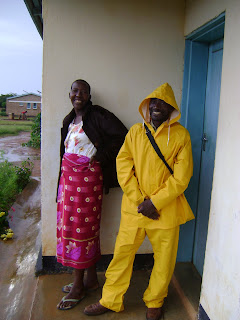
It’s March in Malawi, the height of rainy season. A solid couple hours a day is devoted to steady rain and the occasional stretches of absolute downpour. You can’t leave the house without an umbrella and you better have some sort of waterproof shoes or be ready to splash around in flip flops.
Just imagine a downpour so thick that the smell of rain invades every room of the house. The patter on the roof has climaxed to a uniform roar. Nothing you can do drowns the sound. You can simply bath in it. And if you stand in the right spot in the living room you can actually bath in it too. I guess they didn’t exactly design corrugated metal to be leak proof. Anyhow, what I’m trying to get at is that the sound of a torrential downpour is the most mind deafening sound I’ve ever encountered. I’ve yet to find anything that mutes the sound in any way. Even with my iPod on full blast, earbuds pushed into my ear canal as far as possible; even then the music can’t compete. This is my cry for help, send me ear plugs! When it isn’t a mind-numbing downpour, the soft patter of drops on the corrugated tin is quite soothing. It’s the sort of white noise that babies would easily fall asleep to. And for me, it’s the perfect background noise to cozy up to. The white noise patter is the best, the ideal decibel level.
One can plant a garden by haphazardly tossing seeds on the ground. They nearly sprout on site. The key is to keep the chickens away; they’re as pernicious as a plague of locusts. They’ll walk through a newly planted garden, a hen with a dozen chicks in tow, and henpeck the hell out of anything loose on the ground. I blame the death of my pansies on these ridiculous creatures. If it isn’t already clear, chickens roam free here. The only sort of confines they know is at night when they’re saddled inside the kitchen, from dusk till dawn. But once the sun is up out they are, ready to peck the hell out of anything in sight. Being here gives a whole new meaning to “free range chickens”. Quite frankly, they’re irritating as all hell. The one high note, my neighbor’s chicken has taken to roosting in my outside kitchen. This past week I’ve come up with an egg a day. Guess the mama hen likes my bag of charcoal enough to nest on it. Voila! Farm fresh eggs.
If you haven’t already inferred, mud is a huge problem during this season as well. I spent a large chunk of last Saturday watching a tractor trailer attempt to navigate its way through a former road turned muddy bathtub. So few roads here are paved. Just beyond the reach of the highway, the M1 which curves its way through Malawi, the country’s interstate backbone, all roads are made of various combinations of dirt, sand, and small rocks. And dirt in rainy season becomes mud. A few days of steady downpours and half the roads become soupy messes. Much more fun to hike through barefoot, squishing mud between your toes, than taking a crowded pickup truck leaden with katundu and people. Because then it will only be a matter of just how deep the wheels will sink into the goupy mess and who they nominate to help push the car out. Always a treat to watch though. There’s something fascinating about watching a large group of individuals rocking a car back and forth through deep, muddy gulleys. The sound too. So sloshy, sloupy, slushy, and on. And watch out for the spray, the tire gets one good spin and you’ve been splattered like a Jackson Pollock. The good news is the cars all eventually get out. At least I haven’t seen the mud claim any car as its own, swallowing it into some muddy orifice. But hey, I still have another month or so to go.
All in all, I like rainy season. It’s a nice break from the sweltering heat of chihanya. It’s nice to have a break from the sun. I was starting to believe that clouds were only a wispy figment of my imagination. Now I know they do indeed exist and in great quantity with raindrops big enough to put my eye out. Oh well, inside I go to a good book and a cup of tea. Because now it’s cool enough to want tea. That’s a relief. Let’s hope I get a good white noise patter that will really make my day.
It’s March in Malawi, the height of rainy season. A solid couple hours a day is devoted to steady rain and the occasional stretches of absolute downpour. You can’t leave the house without an umbrella and you better have some sort of waterproof shoes or be ready to splash around in flip flops.
Just imagine a downpour so thick that the smell of rain invades every room of the house. The patter on the roof has climaxed to a uniform roar. Nothing you can do drowns the sound. You can simply bath in it. And if you stand in the right spot in the living room you can actually bath in it too. I guess they didn’t exactly design corrugated metal to be leak proof. Anyhow, what I’m trying to get at is that the sound of a torrential downpour is the most mind deafening sound I’ve ever encountered. I’ve yet to find anything that mutes the sound in any way. Even with my iPod on full blast, earbuds pushed into my ear canal as far as possible; even then the music can’t compete. This is my cry for help, send me ear plugs! When it isn’t a mind-numbing downpour, the soft patter of drops on the corrugated tin is quite soothing. It’s the sort of white noise that babies would easily fall asleep to. And for me, it’s the perfect background noise to cozy up to. The white noise patter is the best, the ideal decibel level.
One can plant a garden by haphazardly tossing seeds on the ground. They nearly sprout on site. The key is to keep the chickens away; they’re as pernicious as a plague of locusts. They’ll walk through a newly planted garden, a hen with a dozen chicks in tow, and henpeck the hell out of anything loose on the ground. I blame the death of my pansies on these ridiculous creatures. If it isn’t already clear, chickens roam free here. The only sort of confines they know is at night when they’re saddled inside the kitchen, from dusk till dawn. But once the sun is up out they are, ready to peck the hell out of anything in sight. Being here gives a whole new meaning to “free range chickens”. Quite frankly, they’re irritating as all hell. The one high note, my neighbor’s chicken has taken to roosting in my outside kitchen. This past week I’ve come up with an egg a day. Guess the mama hen likes my bag of charcoal enough to nest on it. Voila! Farm fresh eggs.
If you haven’t already inferred, mud is a huge problem during this season as well. I spent a large chunk of last Saturday watching a tractor trailer attempt to navigate its way through a former road turned muddy bathtub. So few roads here are paved. Just beyond the reach of the highway, the M1 which curves its way through Malawi, the country’s interstate backbone, all roads are made of various combinations of dirt, sand, and small rocks. And dirt in rainy season becomes mud. A few days of steady downpours and half the roads become soupy messes. Much more fun to hike through barefoot, squishing mud between your toes, than taking a crowded pickup truck leaden with katundu and people. Because then it will only be a matter of just how deep the wheels will sink into the goupy mess and who they nominate to help push the car out. Always a treat to watch though. There’s something fascinating about watching a large group of individuals rocking a car back and forth through deep, muddy gulleys. The sound too. So sloshy, sloupy, slushy, and on. And watch out for the spray, the tire gets one good spin and you’ve been splattered like a Jackson Pollock. The good news is the cars all eventually get out. At least I haven’t seen the mud claim any car as its own, swallowing it into some muddy orifice. But hey, I still have another month or so to go.
All in all, I like rainy season. It’s a nice break from the sweltering heat of chihanya. It’s nice to have a break from the sun. I was starting to believe that clouds were only a wispy figment of my imagination. Now I know they do indeed exist and in great quantity with raindrops big enough to put my eye out. Oh well, inside I go to a good book and a cup of tea. Because now it’s cool enough to want tea. That’s a relief. Let’s hope I get a good white noise patter that will really make my day.
Journal Entries - January 2011
January 21, 2011 Mhalaunda
I learned to bake scones today. I followed the recipe that Mr. Zalimbe uses, the ones he sells to sponsor the People Living with HIV and AIDS (PLWHA) group. He taught both Gabriel and me. They go through a rather tedious process – a very specific way of rolling the dough so it makes a perfect ball for equal expansion. I haven’t made too many rolls in my lifetime, but I’ve never seen anyone be so particular with the rolling process. Folding each flap of dough around and squeezing it between your thumb and forefinger, so a perfect ball emerges. We made 115 scones in just this manner. In the absence of an oven, you preheat a large brick oven, plastered in cement. You build a big fire in the structure, until the bricks trap so much energy they radiate heat. You then remove the wood and charcoal once it’s thoroughly heated. Then you pop in the scones for exactly 7 minutes. Then voila, fresh baked rolls. Pretty nifty. It was an affair that took the whole afternoon though. But the end product, the fresh rolls are absolutely delicious, light and fluffy with just the right amount of sweetness, with a pat of butter they’re to die for.
While we were “preheating” the oven, I noticed a wild fig tree just close by. In Timbuka it’s known as a kachele, a tree whose identity is uniquely tied to the independence of Malawi. It was under a kachele tree that Kamuzu Banda, Malawi’s first president dreamed of education and an independent future for Malawi. On the banks of the Shire River his kachele grew and on that spot he built the Kamuzu Academy, the premier school in Malawi.
So I picked the small figs, a huge bowl full. They’re roughly the size of a cranberry. I had the brilliant idea of making a crisp out of them. It turned out great! I made it just like an apple crisp with a crumb topping; luckily I have cinnamon and nutmeg. So delicious.
January 18, 2011 Mhalaunda
Well I’ve been had. I blame my naiveté on my lack of knowledge of eggs. It’s a new experience for me, eggs that is, not being had. It’s been almost 3 years since I’ve eaten eggs and I just started eating them again. I’m trying to expand my protein input, it’s rather limited in the village to soya pieces and beans, so eggs really extends my food options. And well Mwazi, my next door neighbor’s daughter came by around lunch with a bowl of four eggs. She told me her mother send her over to sell me eggs. I’d just been with her mother at the clinic the day before and I was looking to buy eggs then, but couldn’t find any at a decent price. So, it seemed only natural that she should assist me in my time of need. I bought all 4 at 20 kwacha per egg, roughly 75 cents.
When I sat down to cook them for dinner I couldn’t crack them, I only made a small dent in it. And the one I could crack started to ooze blood. I was quite alarmed, not knowing what the hell was happening. I had just started cooking eggs again and finding bloody eggs was just not in my repertoire. I mean this just wouldn’t happen with store bought eggs in the states. So, I walked out to Mphatso, the girl staying with my other neighbor, and asked her what the problem was. And as I expected they were bad and not just bad, but ready to hatch. New chicks were to hatch in another couple days. Mr. Qoto rode by just as I was explaining the problem. Oh how he laughed at me, “but Chelsea you bought bad eggs, you must know these are bad.” He thought it a good joke until I mentioned it was his daughter who sold me the eggs. Then he perked up, clearly a bit ashamed that his daughter would be the one to cheat me.
We went to confront the girl. She stood in the doorway like an insolent child. She refused to make eye contact with me, standing just enough inside the door so she wouldn’t have to look directly at me. Mr. Qoto asked what she’d done, where she’d taken the eggs from, what she did with the money she got for them. She provided no answers. As it turns out, she’d taken the eggs from Mama Chavula’s roosting hen, when she was supposed to be in school no less. And then over to me she came trying to peddle hot eggs (both literally hot, straight from the chicken’s breast and figuratively hot, stolen eggs).
I swear if that was my child I would have slapped her something good. And I don’t even believe in hitting children, oh but I was beyond pissed. Since she’s not my child I suppose it’s inappropriate for me to hit her. In defense of my urge to strike, the girl has a history of stealing and being dishonest. I was just coming around to her again after the incident where she was caught stealing money from Mama Chavula’s house. On a frequent basis she skips school and is just around the village. That one is not on a good path and now she’s on my shit list for sure. I guess I’ll just have to give her the silent treatment and hope that suffices. And if she ever tries to sell me eggs again I won’t think twice about slapping her.
January 15, 2011 Mhalaunda
So I sprained my ankle. I have a swollen, protruding, bruised mound where my ankle should be. I thought it would be a stellar idea to go on a run this afternoon. And as I started off toward the football ground, the one place I feel comfortable enough to wear running shorts and leggings, I ran across a troop of neighborhood kids. They were just starting a pickup soccer match. Oh hey, I play football and I’m just itching for a chance to prove myself with the area youth. Voila. I’m in and made a team captain. I choose my players, going for the smaller, runtier looking players; they generally tend to be the scrappier ones. We have enough to play full scale, 11-v-11. Off we start, my team can really push the ball up field and I’m part of the push, playing a forward. I get off a shot on goal a few minutes in, SCORE! We’re up 1-0. I make several other good moves around defenders, several great passes. Then, a particularly hard ball comes from a defender aiming to get the ball out of his territory and to the other side of the field. I stick out my left foot, determined to stop its powerful velocity. And snap! The ball drops to a halt directly in front of me and my foot explodes in excruciating pain. I pass the ball off and try to hobble after it, trying to resume my position. I do my best to shake it off, just like my dad would advise. The pain grows worse though, any sort of turn makes a new pain twinge. I finally hobble off the field, trying my best to call in a sub with a few mutterings of jumbled Timbuka.
I hobble my way back home. Now, I’m a loss for what to do. I don’t have ice, so I can’t exactly ice it. Mama Chavula though, she came to the rescue. She brings me one of those ice packs that you bust the inner core and shake it about. She lays me down in bed, propping up my foot. She makes sure I have enough food, nsima patties, a carafe of tea, all the dende (side dishes) I need. She made convalescing that much more enjoyable.
January 14, 2011 Mhalaunda
One thing I’m investing the most time with is helping the People Living with HIV and AIDS group to undertake and continue several projects. I wrote up an action plan to help some of their activities and before I could even deliver the speech I prepared (prepared in Chitimbuka with the help of Gabriel, a friendly neighbor and my language trainer), Mr. Zalimbe approached me with an action plan that the group decided on and drafted. I was so impressed. They brought me the action plan and asked for my help. It’s sort of a role reversal; I’m supposed to bring the plan of action to them. But no matter. Their objectives are obtaining a loan to help with their income-generating activities, namely sewing, knitting, and baking bread, holding trainings for their members on how to live positively, operating a community garden to assist their nutritional needs, etc. It was truly moving. And it was just as powerful even with the few misspellings, say “legislation” for “registration” (Malawians have a funny way of interchanging Ls and Rs). It made me respect them that much more. I’m really looking forward to working with them.
January 13, 2011 Mhalaunda
I was asked to do a new task at the clinic this week. At the St. Francis clinic I sat in on the voluntary counseling and testing sessions with my counterpart, Mr. Makwakwa. I watched and helped him operate the rapid test kit. The clinic is one held monthly for all pregnant women and for children under 5 years. The women attend the clinic monthly throughout their pregnancy. As part of the process, all pregnant women have to be tested for HIV in order to get those women testing positive on the proper medication to prevent mother to child transmission.
At the clinic, we tested 14 women and one came back positive. It was hard to watch as Mr. Makwakwa counseled her. Just looking in on the session, you could tell that she had no idea about her status, no recollection of where she might have been exposed. She is on her third marriage and has never slept with a man outside of marriage. And she looked so healthy and virile, I know that’s a misnomer for a woman’s strength but you get what I mean. By the look of her, you would never guess her HIV status.
As she progressed through the other stages of the antenatal clinic, I snuck glances at her demeanor. She maintained a strong sense of self the whole way through. It filled me with such strength to watch her take on this burden; she developed a sort of stone cold strength. She went through the rest of the clinic just like that, focused on making it through, not giving away a thing. She went through her nursing consultation, through her immunization regime, etc. with inner power and control. I admire her for her strength.
January 11, 2011 Mhalaunda
I’m amazed at the sort of things I’ve become accustomed to, that no longer seem out of the ordinary. I just watched a 13-year-old boy ride by on his bicycle with a large tea kettle strapped to the back, nothing else. The question I want to ask him is where are you going with that tea kettle? Is there anything in the tea kettle? Is it hot? Is the distance you’re traveling far enough to necessitate you carrying it on a bicycle? So many questions, alas I did not ask any of them. I just accepted the sight as part of my daily occurrences. Boy on a ride with a tea kettle. No big deal.
January 9, 2011 Mhalaunda
It’s interesting the things you miss at random when you’ve been out of your natural setting at length. What I miss after six months in Malawi. SMELLS! I wish I have more fine smelling things. Malawi has just a drab, uninviting scent to it. I hate to generalize, I mean there are some nice smelling things, like the groves of citrus fruit or the flowers in my flower bed. But overall, smelling is such an underrated sensuous experience here. The most ubiquitous scent, after traveling up and down the country, is the smell of burning trash. People sweep the streets, collecting all the dust and debris into small piles and then they set it afire. It’s really not so pleasant.
I relish the simple olfactory treasures, like incense, which I burn just about every other day for my “offerings.” I’m also quite thankful that I brought my Miss Dior Cherie perfume with me. On occasion I give it a generous pump, dusting my bed sheets. Inhaling, it’s a beautiful escape. I adore snuggling into my bed after that.
I learned to bake scones today. I followed the recipe that Mr. Zalimbe uses, the ones he sells to sponsor the People Living with HIV and AIDS (PLWHA) group. He taught both Gabriel and me. They go through a rather tedious process – a very specific way of rolling the dough so it makes a perfect ball for equal expansion. I haven’t made too many rolls in my lifetime, but I’ve never seen anyone be so particular with the rolling process. Folding each flap of dough around and squeezing it between your thumb and forefinger, so a perfect ball emerges. We made 115 scones in just this manner. In the absence of an oven, you preheat a large brick oven, plastered in cement. You build a big fire in the structure, until the bricks trap so much energy they radiate heat. You then remove the wood and charcoal once it’s thoroughly heated. Then you pop in the scones for exactly 7 minutes. Then voila, fresh baked rolls. Pretty nifty. It was an affair that took the whole afternoon though. But the end product, the fresh rolls are absolutely delicious, light and fluffy with just the right amount of sweetness, with a pat of butter they’re to die for.
While we were “preheating” the oven, I noticed a wild fig tree just close by. In Timbuka it’s known as a kachele, a tree whose identity is uniquely tied to the independence of Malawi. It was under a kachele tree that Kamuzu Banda, Malawi’s first president dreamed of education and an independent future for Malawi. On the banks of the Shire River his kachele grew and on that spot he built the Kamuzu Academy, the premier school in Malawi.
So I picked the small figs, a huge bowl full. They’re roughly the size of a cranberry. I had the brilliant idea of making a crisp out of them. It turned out great! I made it just like an apple crisp with a crumb topping; luckily I have cinnamon and nutmeg. So delicious.
January 18, 2011 Mhalaunda
Well I’ve been had. I blame my naiveté on my lack of knowledge of eggs. It’s a new experience for me, eggs that is, not being had. It’s been almost 3 years since I’ve eaten eggs and I just started eating them again. I’m trying to expand my protein input, it’s rather limited in the village to soya pieces and beans, so eggs really extends my food options. And well Mwazi, my next door neighbor’s daughter came by around lunch with a bowl of four eggs. She told me her mother send her over to sell me eggs. I’d just been with her mother at the clinic the day before and I was looking to buy eggs then, but couldn’t find any at a decent price. So, it seemed only natural that she should assist me in my time of need. I bought all 4 at 20 kwacha per egg, roughly 75 cents.
When I sat down to cook them for dinner I couldn’t crack them, I only made a small dent in it. And the one I could crack started to ooze blood. I was quite alarmed, not knowing what the hell was happening. I had just started cooking eggs again and finding bloody eggs was just not in my repertoire. I mean this just wouldn’t happen with store bought eggs in the states. So, I walked out to Mphatso, the girl staying with my other neighbor, and asked her what the problem was. And as I expected they were bad and not just bad, but ready to hatch. New chicks were to hatch in another couple days. Mr. Qoto rode by just as I was explaining the problem. Oh how he laughed at me, “but Chelsea you bought bad eggs, you must know these are bad.” He thought it a good joke until I mentioned it was his daughter who sold me the eggs. Then he perked up, clearly a bit ashamed that his daughter would be the one to cheat me.
We went to confront the girl. She stood in the doorway like an insolent child. She refused to make eye contact with me, standing just enough inside the door so she wouldn’t have to look directly at me. Mr. Qoto asked what she’d done, where she’d taken the eggs from, what she did with the money she got for them. She provided no answers. As it turns out, she’d taken the eggs from Mama Chavula’s roosting hen, when she was supposed to be in school no less. And then over to me she came trying to peddle hot eggs (both literally hot, straight from the chicken’s breast and figuratively hot, stolen eggs).
I swear if that was my child I would have slapped her something good. And I don’t even believe in hitting children, oh but I was beyond pissed. Since she’s not my child I suppose it’s inappropriate for me to hit her. In defense of my urge to strike, the girl has a history of stealing and being dishonest. I was just coming around to her again after the incident where she was caught stealing money from Mama Chavula’s house. On a frequent basis she skips school and is just around the village. That one is not on a good path and now she’s on my shit list for sure. I guess I’ll just have to give her the silent treatment and hope that suffices. And if she ever tries to sell me eggs again I won’t think twice about slapping her.
January 15, 2011 Mhalaunda
So I sprained my ankle. I have a swollen, protruding, bruised mound where my ankle should be. I thought it would be a stellar idea to go on a run this afternoon. And as I started off toward the football ground, the one place I feel comfortable enough to wear running shorts and leggings, I ran across a troop of neighborhood kids. They were just starting a pickup soccer match. Oh hey, I play football and I’m just itching for a chance to prove myself with the area youth. Voila. I’m in and made a team captain. I choose my players, going for the smaller, runtier looking players; they generally tend to be the scrappier ones. We have enough to play full scale, 11-v-11. Off we start, my team can really push the ball up field and I’m part of the push, playing a forward. I get off a shot on goal a few minutes in, SCORE! We’re up 1-0. I make several other good moves around defenders, several great passes. Then, a particularly hard ball comes from a defender aiming to get the ball out of his territory and to the other side of the field. I stick out my left foot, determined to stop its powerful velocity. And snap! The ball drops to a halt directly in front of me and my foot explodes in excruciating pain. I pass the ball off and try to hobble after it, trying to resume my position. I do my best to shake it off, just like my dad would advise. The pain grows worse though, any sort of turn makes a new pain twinge. I finally hobble off the field, trying my best to call in a sub with a few mutterings of jumbled Timbuka.
I hobble my way back home. Now, I’m a loss for what to do. I don’t have ice, so I can’t exactly ice it. Mama Chavula though, she came to the rescue. She brings me one of those ice packs that you bust the inner core and shake it about. She lays me down in bed, propping up my foot. She makes sure I have enough food, nsima patties, a carafe of tea, all the dende (side dishes) I need. She made convalescing that much more enjoyable.
January 14, 2011 Mhalaunda
One thing I’m investing the most time with is helping the People Living with HIV and AIDS group to undertake and continue several projects. I wrote up an action plan to help some of their activities and before I could even deliver the speech I prepared (prepared in Chitimbuka with the help of Gabriel, a friendly neighbor and my language trainer), Mr. Zalimbe approached me with an action plan that the group decided on and drafted. I was so impressed. They brought me the action plan and asked for my help. It’s sort of a role reversal; I’m supposed to bring the plan of action to them. But no matter. Their objectives are obtaining a loan to help with their income-generating activities, namely sewing, knitting, and baking bread, holding trainings for their members on how to live positively, operating a community garden to assist their nutritional needs, etc. It was truly moving. And it was just as powerful even with the few misspellings, say “legislation” for “registration” (Malawians have a funny way of interchanging Ls and Rs). It made me respect them that much more. I’m really looking forward to working with them.
January 13, 2011 Mhalaunda
I was asked to do a new task at the clinic this week. At the St. Francis clinic I sat in on the voluntary counseling and testing sessions with my counterpart, Mr. Makwakwa. I watched and helped him operate the rapid test kit. The clinic is one held monthly for all pregnant women and for children under 5 years. The women attend the clinic monthly throughout their pregnancy. As part of the process, all pregnant women have to be tested for HIV in order to get those women testing positive on the proper medication to prevent mother to child transmission.
At the clinic, we tested 14 women and one came back positive. It was hard to watch as Mr. Makwakwa counseled her. Just looking in on the session, you could tell that she had no idea about her status, no recollection of where she might have been exposed. She is on her third marriage and has never slept with a man outside of marriage. And she looked so healthy and virile, I know that’s a misnomer for a woman’s strength but you get what I mean. By the look of her, you would never guess her HIV status.
As she progressed through the other stages of the antenatal clinic, I snuck glances at her demeanor. She maintained a strong sense of self the whole way through. It filled me with such strength to watch her take on this burden; she developed a sort of stone cold strength. She went through the rest of the clinic just like that, focused on making it through, not giving away a thing. She went through her nursing consultation, through her immunization regime, etc. with inner power and control. I admire her for her strength.
January 11, 2011 Mhalaunda
I’m amazed at the sort of things I’ve become accustomed to, that no longer seem out of the ordinary. I just watched a 13-year-old boy ride by on his bicycle with a large tea kettle strapped to the back, nothing else. The question I want to ask him is where are you going with that tea kettle? Is there anything in the tea kettle? Is it hot? Is the distance you’re traveling far enough to necessitate you carrying it on a bicycle? So many questions, alas I did not ask any of them. I just accepted the sight as part of my daily occurrences. Boy on a ride with a tea kettle. No big deal.
January 9, 2011 Mhalaunda
It’s interesting the things you miss at random when you’ve been out of your natural setting at length. What I miss after six months in Malawi. SMELLS! I wish I have more fine smelling things. Malawi has just a drab, uninviting scent to it. I hate to generalize, I mean there are some nice smelling things, like the groves of citrus fruit or the flowers in my flower bed. But overall, smelling is such an underrated sensuous experience here. The most ubiquitous scent, after traveling up and down the country, is the smell of burning trash. People sweep the streets, collecting all the dust and debris into small piles and then they set it afire. It’s really not so pleasant.
I relish the simple olfactory treasures, like incense, which I burn just about every other day for my “offerings.” I’m also quite thankful that I brought my Miss Dior Cherie perfume with me. On occasion I give it a generous pump, dusting my bed sheets. Inhaling, it’s a beautiful escape. I adore snuggling into my bed after that.
Subscribe to:
Posts (Atom)